Essay TikTok Ad Creative
TikTok Ad Creative Fatigue and Burn Rate on the for You Feed
Why TikTok ads die in days while Meta ads last for weeks.
TikTok creative fatigue and Meta creative fatigue look the same on a dashboard, but they come from two different machines. Meta fatigue is audience exhaustion: the same users see the same ad at rising frequency until they stop responding to it. The algorithm isn't punishing the ad in that scenario, it's showing a tired ad to a tired audience. CTR falls, CPC rises, but the ad itself hasn't been cut. The people looking at it have simply seen it too many times.
TikTok runs on a different logic: the platform watches whether an ad holds viewers in the first two seconds, and when early retention drops below what TikTok expects, it reads that as a poor user experience and cuts distribution. The platform doesn't wait for people to get sick of an ad. It stops serving the ad the moment the opening fails to hold attention, then forces the advertiser to compete for fewer, pricier impressions.
Part of this comes down to how the For You Page is built. Users judge ads by the same standard they apply to organic content, scrolling past anything that doesn't earn its first second. An opening that held a strong share of viewers past the first two seconds at launch can collapse to a fraction of that within days, simply because the trend cycle moved on and the hook started to feel dated.
This distinction sets the terms for everything that follows. Because the suppression signal is a creative-quality signal and not a frequency number, advertisers trained on Meta's playbook will keep watching the wrong metric. They'll wait for frequency to climb, or for CPA to break, and by the time either of those moves, the algorithm has already made its decision and moved the budget elsewhere.
The Average TikTok Ad Lifecycle, Day By Day
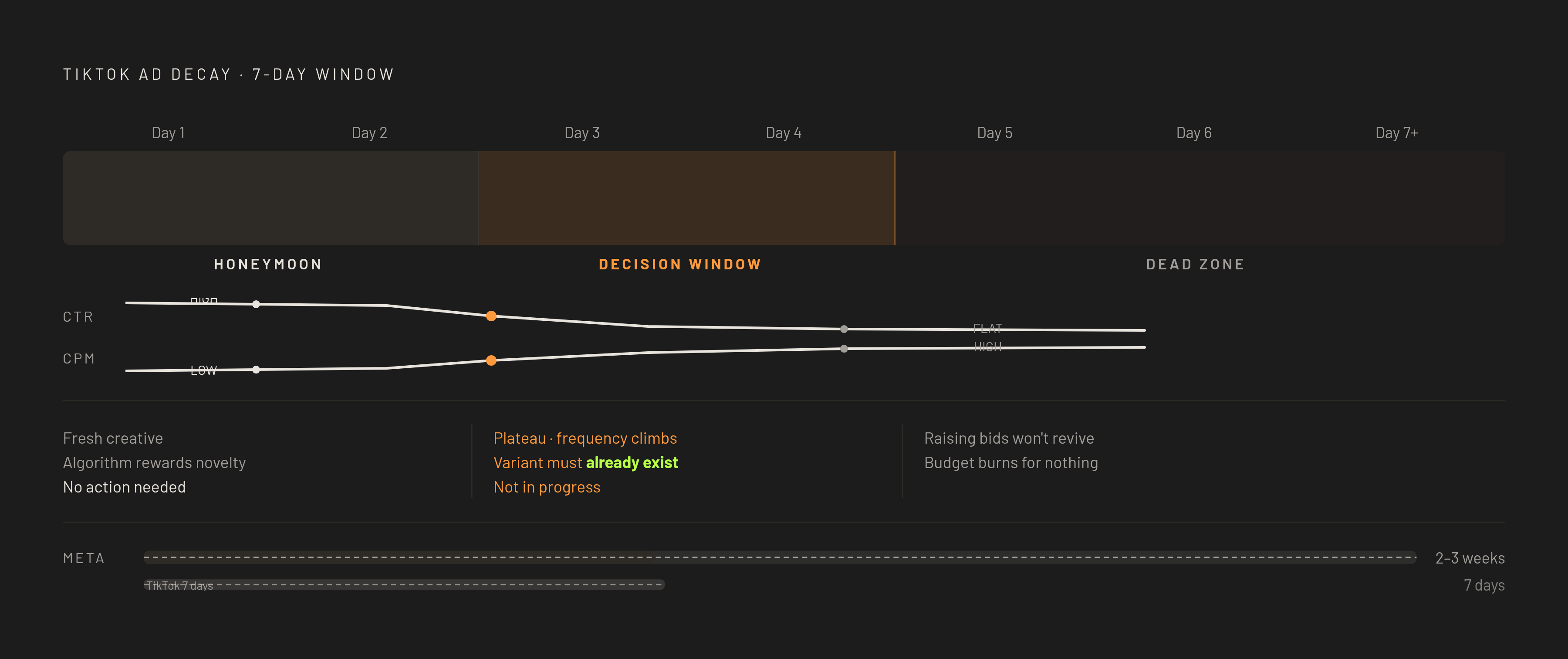
TikTok creative decay follows a pattern so tight you can set a clock by it. Days 1 and 2 are the honeymoon phase: the creative is fresh, the algorithm rewards that novelty, CPMs sit low, and CTRs run high. Nothing needs to happen yet.
Days 3 and 4 are where the real decision gets made. Performance plateaus. The algorithm has already shown the creative to its most responsive audience segments, frequency starts climbing, and CPMs tick up slightly. This is the window where a fresh variant needs to already be built and ready to go, not the moment someone starts thinking about building one.
By day 7, the creative is effectively dead. Spend past that point burns budget for diminishing returns, and raising bids won't bring it back. The gap between the old creative dying and the new creative launching is where most TikTok advertisers lose the bulk of their money, not in any single bad decision but in the dead space between decay and replacement.
Compare that to Meta, where a single concept can run for two to three weeks before meaningful decay sets in, and some evergreen angles hold for months with the right audience rotation. TikTok's window runs roughly two to three times shorter. The practical cost appears before ROAS or CPA ever move: those numbers are lagging indicators, and by the time they shift, the spend behind them is already gone.
Reading TikTok Ads Manager for suppression signals before performance crashes
The earliest and most reliable fatigue signal on TikTok is a creative-quality metric: Average Play Time in the first two seconds. The Average Play Time per video view sits there, and it tells a story frequency never will.
A healthy ad loses viewers gradually as the video runs on. A fatigued ad shows a cliff, a sharp drop within the first two seconds. When that cliff appears, the hook has fatigued and the creative has stopped earning the watch. This also explains a good share of TikTok ads that fail to convert: traffic that never watches past the first two seconds rarely buys anything, no matter how strong the offer is further down the funnel.
Four other signals, watched together, confirm suppression is underway. A meaningful drop in CTR against a seven-day rolling baseline is the cleanest read on audience wear-out, because it normalizes for cost. A sharp slide in three-second hook rate from its launch level points to a creative problem. Frequency pushing past the 2.0 to 3.0 range on cold prospecting traffic is also a red flag: those audiences shouldn't see the same ad four or more times in a seven-day window, and when they do, the ad set usually lacks creative depth.
Context separates signal from noise. Same audience, same setup, worse hold: the creative is the variable that changed, and the right read comes from the week-over-week trend. Separating fatigue from saturation before reacting matters too. Getting this backwards wastes money in both directions, because weeks of new video production will never fix a saturation problem. These four signals need daily eyes, not weekly ones. TikTok's decay happens inside a three-to-four day window, and a weekly check arrives after the decision point has already passed.
The compounding burn problem: creative DNA and shared hooks
Fatigue doesn't stay contained to a single ad. Frequency on that hook compounds across the whole portfolio, invisibly, because no single ad's reporting captures it.
TikTok's engine runs on the first three seconds, and hooks get used up. The exact frame that drove strong performance on day two gets pattern-matched and skipped by day nine, even if it's technically appearing inside a "new" ad. The algorithm applies the same logic: it rewards genuine novelty, not a cosmetic change dressed up as a new creative.
The practical fix for this starts with an audit, not a new shoot. Before you launch a new batch, map the opening three seconds of every active ad. If more than one shares the same hook type, they're compounding burn on a single asset, even though the campaign structure treats each one as independent.
Why the production math forces a structural answer
TikTok creatives burn out in days, not weeks, and that single fact changes what "enough creative" means. Traditional shoot-based production is built around weeks-long timelines and monthly batches, so it can't keep pace with a platform that expects a new hook every three to four days.
Most brands hit a production ceiling well below what TikTok needs for sustained performance. The gap between what a team can produce and what the platform consumes is exactly where performance declines live, and no amount of bidding strategy closes that gap. Budget poured into a fatigued creative doesn't restore the algorithm's confidence in it. It accelerates the suppression.
Audience size sets the fatigue clock as much as the creative itself does. A narrow audience needs a faster refresh cadence to match, which makes audience size a production-planning input and not just a targeting decision.
The platform's own push toward automated campaign tools adds more pressure here. You can't solve any of this by working harder inside the old production model. It requires a different one.
Users judge ads by the same standard they apply to organic content, scrolling past anything that doesn't earn its first second.
Modular creative production as the structural fix for TikTok's burn rate
Modular production solves the volume demand by breaking an ad into interchangeable parts, preserving the formula that's already proven itself and replacing only the worn-out piece. That means no full rebuild every time an ad dies.
A modular ad separates into three layers. The hook, running from 0 to 3 seconds, is the opening visual, line, or pattern that stops the scroll, and it's the highest-burn component, needing the most frequent variation. The core body carries the product demonstration, the problem-solution sequence, or the value proposition, the heavy lifting that's already proven it converts, and that part gets preserved while only the hook and closing call to action change. The closing call to action burns the slowest and changes the least often.
Refreshing a modular ad means swapping the fatigued surface, a new hook line, a new opening visual, a new angle, and the winning formula that already proved itself stays in place. Producing a variation on a proven winner this way is far faster and far cheaper than a new shoot from scratch.
The cadence discipline matters as much as the structure itself. Ship two to three fresh variations before frequency climbs, not after CTR has already collapsed. Retire the fatigued cut, promote the freshest variation, and queue the next one on a fixed schedule. If you wait to refresh until the numbers crash, the budget is already spent on a dying asset. Modular production also matches what TikTok's own platform tools are nudging advertisers toward: features like Auto-Selection are built to source, test, and scale creative assets automatically, which signals that TikTok itself expects frequent refresh as the baseline, not the exception. Modular production is the operational way to deliver that refresh without burning out a creative team trying to build everything from zero every week.
How AI tools compress the feedback loop between creative hypothesis and performance data
Teams using AI-assisted creative production publish meaningfully more testable variants than teams relying on traditional workflows. AI's advantage is that it compresses the time between forming a creative hypothesis and seeing the performance data that confirms or kills it.
That compression plugs directly into the modular system described above. AI-assisted script generation, thumbnail testing, and automated variant production let a team produce a large batch of hook variations from a single proven body, which is exactly the high-burn component that needs the most frequent refresh. Instead of waiting on a production cycle to generate five new hook ideas, a team can generate dozens and let the data sort the winners.
The volume matters less than the speed of the loop it creates. More testable variants in the market sooner means suppression signals surface faster, winners get identified before budget is wasted on the losers sitting next to them, and the next rotation is already queued by the time the current one starts to fade. TikTok's own Auto-Selection feature, which sources and scales top-performing assets automatically across brand uploads, creator content, and AI-generated content, reflects the same principle from the platform's side: fatigue gets managed by constant testing against a live feed, not by picking one ad and hoping it holds.
What competitor creative intelligence reveals about fatigue strategy
Watching how long competitors run the same creative, and when they rotate it out, says something concrete about whether a given hook angle has sustainable economics in a category. A creative that stays live for weeks is typically earning its keep. Rapid churn across a competitor's library usually signals testing chaos, or a fatigue problem they've already run into and are reacting to.
TikTok's Creative Center gives free access to top-performing ads sorted by category and objective, so it's a useful starting point if you want to see which hook types and opening formats are currently earning strong early retention in a given vertical. The limitation is that it's siloed. Cross-referencing a competitor's TikTok activity against what they're running on Meta takes a separate interface, because TikTok's Creative Center, Meta's Ad Library, and Google's Ads Transparency Center don't talk to each other.
Paid intelligence platforms close that gap. The strategic value is visible in the comparison itself: a competitor rotating hooks every three to four days has already learned the burn rate lesson the hard way, and that cadence becomes a benchmark to calibrate against rather than something to discover through a blown budget.
How TikTok's creative tempo distorts the multi-channel production calendar
TikTok's urgency doesn't stay contained to TikTok's line item. Teams running campaigns across TikTok, Meta, Google, LinkedIn, and Reddit without a separated creative allocation find TikTok's three-to-four-day refresh cycle pulling attention away from everything else. New creatives get rushed out to TikTok because the suppression clock is ticking, Meta assets quietly age past their effective window because nobody's watching them, and LinkedIn campaigns run on generic copy because there's no bandwidth left to write anything sharper.
TikTok's fast cycle also works as a diagnostic beyond its own platform. A CTR drop on TikTok can foreshadow the same decline landing on Meta and other channels a bit later. Read correctly, TikTok functions as an early warning system for the whole creative portfolio, not just a demanding channel in its own right.
The operational fix is this: stop treating TikTok's creative output as something the existing production team can just absorb for free. TikTok's creative throughput needs its own planned capacity, separated from the pool the rest of the calendar draws from.
What growth-stage brands get wrong about TikTok creative operations
Most growth-stage brands bring a Meta operating model to TikTok: a small library of creative assets, creative reviews on a monthly or biweekly cycle, and bid adjustments as the main lever when something underperforms. TikTok's suppression mechanics punish that model inside two weeks, every time.
The failure pattern repeats with little variation. A brand launches three to five creatives, two of them perform well, bids get raised to capitalize on the winners, frequency climbs, suppression kicks in by day seven, and the budget gets burned while the team diagnoses it as an auction problem or an audience problem. It's neither. It's a creative supply problem, and no amount of bid strategy fixes a supply problem.
The durable setup rests on three things working together. And a production model, whether self-serve and AI-assisted or fully managed, that keeps TikTok's creative throughput separate from the rest of the paid media calendar so other channels don't quietly starve for attention.
TikTok fatigue is predictable, it's detectable early, and it's beatable. The advertisers who manage it understand that the mechanism is algorithm suppression driven by hook decay, not audience exhaustion, and they build their creative operations around that reality instead of importing a model built for a different platform.